




Super Teams: From Automation to Accountability
 Article
- On effective human-AI teams, AI contributes speedy analysis, evidence-based intelligence, pattern recognition, and scale while people focus on innovative thinking, analytical reasoning, creativity, values-based judgment, and contextual understanding.
- Organizations that take the greatest advantage of AI are those that redesign workflows so that people interact continuously with AI rather than treat it as an isolated tool.
- To lead super teams, students must learn to build trust in AI systems, foster cultures of experimentation, and take accountability for AI-assisted outcomes.
Artificial intelligence is driving a shift not only in how people work, but in how teams make decisions, solve problems, and innovate. This shift is giving rise to the human-AI “super team” in the workplace, where humans view AI not merely as a tool for automation but as an active partner in decision-making, problem-solving, and innovation.
AI can perform pattern recognition and data analysis with speed and accuracy, while humans contribute critical thinking, creativity, ethical judgment, empathy, and contextual understanding. As a result, human-AI super teams can process information faster, make more informed strategic decisions, respond more quickly to changing situations, and experiment with new ideas at a lower cost than conventional teams where technology plays only a supporting role.
For organizations, the challenge is no longer limited to how to adopt AI. It has expanded to how they can redesign work processes to enable seamless human-AI collaboration. As businesses continue their digital transformation, super teams are a key model for achieving sustainable competitive advantage.
How Super Teams Work
Organizations that embrace super teams use AI to augment human skills, not replace them. This change in mindset affects nearly every part of organizational culture. As leaders rethink how work gets done, how decisions are made, and how value is created, they are making changes in the following areas:
Workflow design. Business leaders cannot simply insert AI into existing processes. They must reimagine workflows so that human-machine interaction is continuous. The best teams design processes where insights flow seamlessly between people and systems, enabling better decisions, greater innovation, and higher performance.
The rise of super teams is a force that is already reshaping the ways organizations operate and compete in their markets.
Trust. Leaders must ensure that the human members of super teams understand how AI works, when to rely on it, and when to question it. Transparency and training play key roles in building this confidence.
Leadership development. Leaders must not only possess technical skills, but also understand the capabilities and limits of AI, foster collaboration between technical and nontechnical talent, and create cultures that embrace experimentation and learning.The rise of super teams is not some distant trend. It is a new leadership challenge—a force that is already reshaping the ways organizations operate and compete in their markets. Organizations that master this model won’t just become more efficient. They will become fundamentally more capable.
A Human-AI Model
Decision-making on super teams follows a five-step process:
- The members of super teams first allocate work based on capabilities. Tasks are assigned based on the unique strengths of humans and AI rather than traditional role boundaries.
- They draw on AI-driven analysis and insights. AI continuously processes information, identifies patterns, predicts possible outcomes, and recommends potential solutions.
- They incorporate human interpretation and judgment. Humans evaluate AI-generated insights by considering business objectives, ethical implications, and practical real-world factors.
- They engage in collaborative decision-making. AI provides evidence, analysis, and alternatives, while humans apply experience, critical thinking, and strategic judgment.
- They demonstrate human accountability. Although AI assists in decision-making, humans are ultimately the ones who take responsibility for outcomes and ensure decisions are accurate, ethical, and aligned with organizational goals.
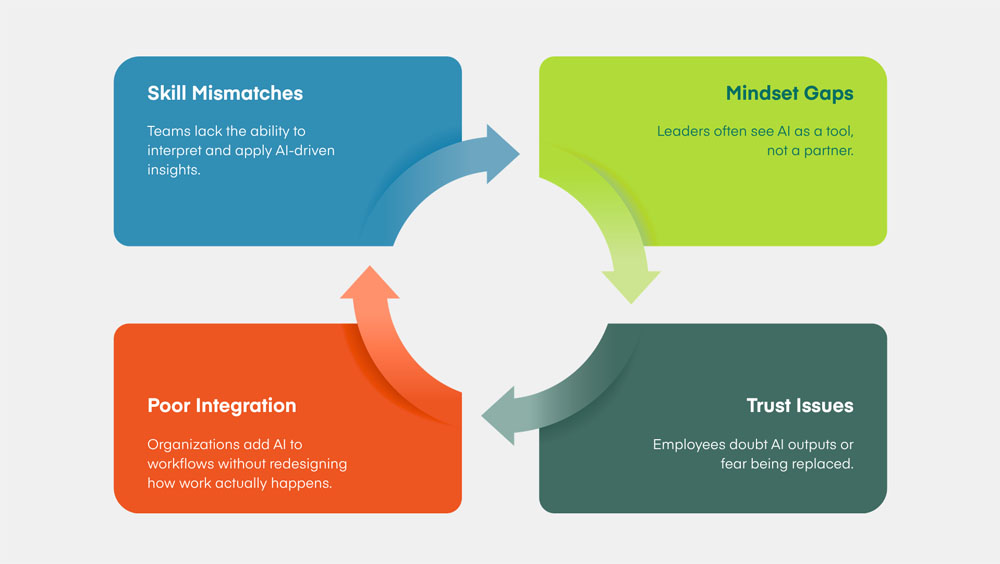
While super teams offer strong potential, many organizations find them hard to build, facing challenges like skill gaps and poor integration into daily workflows. Some of their employees might mistrust AI due to the fear it will take over their roles altogether; others misunderstand AI’s place and potential in improving their own performance and the performance of their companies.
These challenges can become linked in a vicious cycle, reinforcing themselves in ways that hinder successful AI adoption, not only within individual teams but across the entire organization:
Companies that are able to overcome these difficulties can maximize the potential of the super-team concept, as proven by early adopters. Walmart, for example, uses AI to forecast demand, optimize delivery routes, and automatically rebalance inventory, while employees oversee operations and act on the insights generated by these systems. Through this teamwork, the company has created a “self-healing” inventory system that has reportedly saved more than 55 million USD.
Teams at the global delivery company DHL use generative AI to clean and analyze customer data so that they can address complex customer and operational issues more effectively and prepare logistics proposals more quickly. Employees at the global energy company Schneider Electric combine AI and other digital technologies with their own expertise to improve manufacturing efficiency, which has allowed them to support business growth while addressing emissions and sustainability requirements.
In the everyday roles that business school graduates will assume, they are likely to interpret AI-generated information, solve business problems, communicate with teams, make decisions, and identify opportunities for improvement. For example, graduates working in supply chain might use AI to analyze demand and identify delays but use personal judgment to decide the best action. Graduates working in marketing could use AI to identify customer trends to better understand consumer needs before using that information to create hands-on campaigns.
The first step in building super teams that can achieve similar goals for their organizations is not adopting new technology. It’s changing people’s minds. Therefore, schools should make teaching students how to overcome these challenges an integral part of leadership development.
What This Looks Like in the Curriculum
If organizations are increasingly relying on super teams, how should business schools update their curricula? How can they sufficiently prepare students to work confidently with AI technologies, overcome the challenges of AI adoption, and develop the human capabilities that complement AI’s contributions? The most successful preparation encompasses wide-ranging objectives:
Offering an interrelated selection of courses in the areas of business analytics, AI ethics and governance, AI’s applications in business, and design thinking with AI. These courses should be complemented by AI-enabled simulations and capstone projects that prepare graduates for AI-driven workplaces.
Helping students build foundational knowledge about AI, data analytics, and digital technologies alongside management concepts, so they come to understand AI capabilities and limitations. They should learn how AI generates insights, what its strengths and limitations are, and how it can be applied to solve business problems.
Integrating AI-powered tools into classroom activities such as realistic business simulations, live industry projects, case studies, consulting assignments, and cross-functional team exercises. Such experiences allow students to practice integrating AI into business processes and learn to redesign workflows so that human judgment and machine intelligence enhance each other.
Developing uniquely human skills such as critical thinking, creativity, ethical reasoning, communication, negotiation, collaboration, and emotional intelligence.
The first step in building super teams is not adopting new technology. It’s changing people’s minds.
Focusing on leadership development. Future managers must learn how to redesign workflows; build trust in AI systems; encourage collaboration between technical and nontechnical professionals; and foster cultures of innovation, experimentation, and continuous learning.
Emphasizing accountability. Students must understand that humans ultimately are accountable for the outcomes of their decisions, even when AI contributes to the decision-making process.
The goal for any business school is to ensure that students understand AI’s potential and realize that, if used correctly, this technology will enhance both their performance and that of their organizations. Schools build this understanding when they focus a greater portion of their curricula on the areas above.
Honing Human-AI Collaboration
In the coming years, the competitive gap between organizations will not be defined by who has access to AI, because most will. It will be defined by who knows how to use it effectively. The winners will be those who design systems where human and machine intelligence reinforce each other, creating outcomes neither could achieve alone.
When business school programs combine the development of business knowledge and leadership capabilities with the honing of strong human skills, graduates will be well equipped to lead the next generation of super teams. In the end, business schools must prepare students to become AI-enabled managers, not simply AI users.
 Video
Video